Blog
Dental hygiene tips for healthy teeth & gums
Comparing Your Teeth Straightening Options: Which Fits Your Life?
Most patients walk in asking about price and visibility. Those matter, but neither one tells you what it’s actually like to live with teeth straightening options for one to three years.
Braces that are clinically ideal don’t work if the patient stops showing up for adjustments. Aligners that would produce a good result don’t work if they spend fourteen hours a day on a bedside table. The option that fits the clinical picture and the patient’s life is the one that actually gets finished.
What follows is a comparison of types of teeth straightening from that angle, not just what each one does to teeth, but what each one asks of the person wearing it.
TL;DR
- There are five types of teeth straighteningtraditional braces, clear aligners, ceramic braces, lingual braces, and direct-to-consumer kits. Most patients pick based on price and visibility.
- Each comes with compliance demands and daily realities that most patients aren’t told about upfront.
- The best option fits both the clinical need and how someone actually lives. A treatment plan that doesn’t get followed doesn’t produce a result.
What Living With Traditional Braces Actually Looks Like
Traditional metal braces are fixed. They go on, they stay on, and for the duration of treatment there’s no opting out on a given day. For patients who worry about compliance, that’s actually the point. The treatment moves forward regardless of motivation because there’s no device to remove.
The daily adjustments are real. Anything hard, sticky, or chewy is off the menu, and that’s not theoretical. A bracket that breaks from a chip or a piece of crusty bread means an extra appointment and potentially added time to treatment if it stays broken too long. Most patients break at least a few brackets. Some break them regularly.
Hygiene around brackets takes longer than cleaning natural teeth. Food traps around brackets and under wires, and plaque that isn’t cleared consistently leads to decalcification, white spots on the enamel that can remain permanently after the brackets come off. It’s visible on a significant number of patients who didn’t adjust their hygiene routine during treatment.
Cost typically runs $3,000 – $7,000, with treatment time between 18 months and three years for most cases.
What Living With Clear Aligners Actually Looks Like
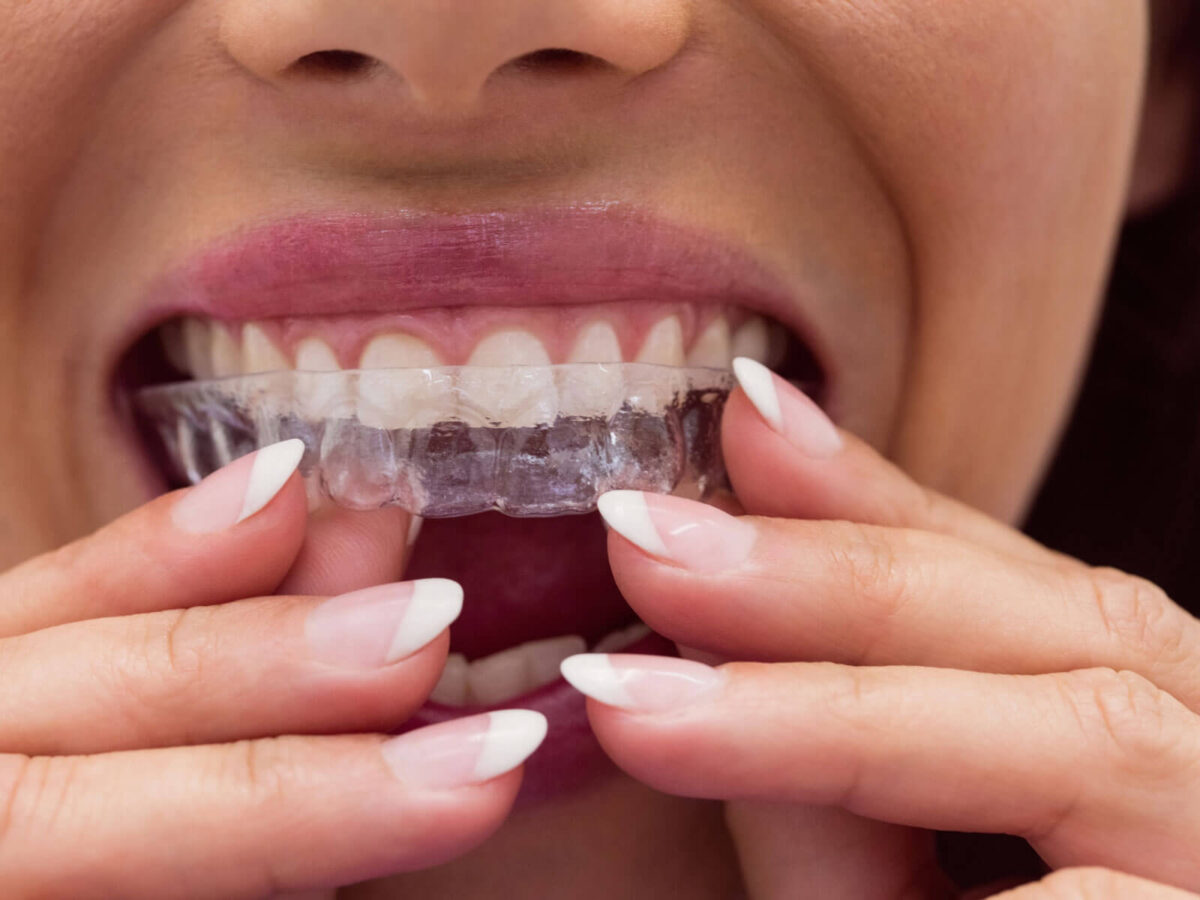
Clear aligners are the teeth straightening option most adults default to. They’re removable, nearly invisible, and don’t restrict diet. On paper, they fit into most lives more easily than any fixed appliance.
The compliance demands are harder than most patients expect. Twenty-two hours of daily wear isn’t a guideline. It’s what the treatment math is built on. Skip too many hours, and the next tray won’t fit, refinements get added, and the end date moves.
Taking them out for every meal, every coffee, every social situation adds up faster than most people anticipate. The American Association of Orthodontists notes that outcomes vary significantly based on wear compliance. Cost runs $3,000 – $8,000.
What Living With Ceramic Braces Actually Looks Like
The patients I see choosing ceramic braces are almost always doing it to avoid the look of metal. The brackets are tooth-colored and much less obvious from a normal distance, but nobody should walk in expecting invisible. I’ve had patients genuinely surprised by how visible the brackets still are when someone is standing close.
Ceramic chips more easily than metal, so the food restrictions are stricter, not looser. A bracket that breaks mid-treatment is also harder to replace seamlessly than a metal one.
Adjustment appointments are typically every four to eight weeks, and the elastic ties pick up color from coffee, tea, and food throughout. Patients who drink coffee daily are dealing with visible staining on the ties for most of treatment.
Cost runs $4,000 – $8,000, with treatment time comparable to metal braces.
Is One Option Clearly Better for Your Situation?
The answer depends on more than aesthetics and price. A proper assessment shows what your teeth need and what each option realistically involves.
Why Do Some Patients Choose Lingual Braces Over Everything Else
Lingual braces are invisible from the front. Brackets sit on the inner surfaces of the teeth, entirely out of sight. For patients for whom visibility is the central concern, and aligners aren’t appropriate for their case complexity, lingual braces solve that problem completely.
The adjustment period is longer than any other appliance. Brackets on the tongue-side surface affect speech immediately after placement. Most patients normalize within two to four weeks, but those first weeks are noticeably difficult.
Cleaning is more demanding too. The brackets are less accessible, and standard brushing doesn’t reach them without technique adjustments and additional tools.
At $8,000 to $13,000, lingual braces are the most expensive of the fixed options for straightening teeth. For patients in public-facing roles where any visible appliance creates professional concern, they’re the only fixed option that’s genuinely invisible.
What Living With Direct-to-Consumer Aligner Kits Actually Looks Like
With direct-to-consumer kits, aligner trays show up at the door. No clinical assessment, no in-person appointment, no X-rays. The price, typically $1,500 – $2,500, is the primary appeal.
The daily experience is similar to clinic-based aligners. The compliance demands are the same: consistent wear, removal for eating, cleaning before reinserting.
The difference is monitoring. Clinic-based treatment includes regular check appointments where an orthodontist assesses whether teeth are tracking as planned and catches problems as they develop. With DTC kits, the trays progress on a fixed schedule regardless of how the teeth are actually moving. By the time the patient notices something is off, the misalignment has progressed through multiple tray changes.
The AAO has documented cases where DTC treatment produced unintended bite changes requiring clinical correction. Determining whether a case is mild enough for DTC requires the clinical assessment those platforms skip.
What Orthodontic Treatment Asks of You Regardless of Option
Most patients don’t hear about these things until they’re already in treatment.
Retention doesn’t end when treatment does. Whatever appliance straightens the teeth, they want to return toward their original positions once it comes off. A fixed retainer, a removable one worn nightly, or both – that routine continues indefinitely. Patients who stop retainer wear within a few years of finishing treatment see relapse. Some see significant relapse.
With fixed appliances, the food restrictions don’t ease up partway through. A two-year case means two years of the same list.
Hygiene requirements increase with every appliance type. More surfaces, more tools, more time. Patients who don’t adjust their routine during treatment can finish with straight teeth and enamel damage or gum problems that weren’t there when they started.
Appointments matter too. Missing adjustment visits or monitoring appointments adds time and sometimes undoes progress.
FAQ
What are the main teeth straightening options?
Five come up regularly – traditional braces, clear aligners, ceramic braces, lingual braces, and direct-to-consumer kits. Each one handles a different range of tooth movement and comes with its own daily realities.
Which teeth straightening option is easiest to live with?
Clear aligners have the fewest lifestyle restrictions on paper – no food limits, removable, nearly invisible. What most patients underestimate is the 22-hour daily wear requirement. If that’s going to be a problem, braces take the decision out of your hands.
What’s the problem with direct-to-consumer aligner kits?
The risk is lower for very mild cases with healthy bone and no bite involvement. The problem is that confirming a case actually qualifies requires the clinical assessment those platforms don’t do.
Do all straightening options require retainers afterward?
Yes. Teeth move toward their original positions without retention, and that tendency doesn’t diminish over time. The retainer routine continues regardless of which appliance was used.
Conclusion
Teeth straightening options look different from the inside of treatment than they do in a comparison article. The visibility of ceramic braces, the compliance demand of aligners, the speech adjustment with lingual brackets, the food restrictions with any fixed appliance. These are the things that determine whether someone actually finishes.
For Mathis patients comparing options for straightening teeth, the clinical fit matters and so does the lifestyle fit. Understanding both sides of that is what makes the choice hold up over the course of treatment.
Find Out Which Option Works for Your Teeth and Your Life
A proper assessment covers the clinical picture and the practical one.